
Module 10: Stand Up To Sitting Disease
Have you noticed any of these warning signs?
- Rubbing sore muscles and joints frequently?
- Struggling to get comfortable in your chair?
- Standing or stretching often for relief?
- Rubbing sore, tired or blurry eyes?
- Difficulty concentrating or remembering things
The truth of the matter

Many of us have heard the phrase, “Sitting is the new smoking”. But did you know that prolonged sitting can also affect your mental performance and memory? That’s Right. Even with good posture and equipment, sitting over 1-2 hours straight without a break will eventually leave you stiff and sore and may affect your mental performance. This will only worsen as the day goes on if you do not include enough of the right kinds of movement breaks. https://bmcmusculoskeletdisord.biomedcentral.com/articles/10.1186/s12891-021-04136-5
Effects of prolonged sitting
- Reduced mental performance and memory
- Muscle and joint stiffness
- Reduced circulation, especially in your hips and legs (you are sitting on them)
- Reduced lymphatic circulation
- Tightening of muscles on the front side of your body
- Weakened postural muscles on the back of your body
- Shallow respirations from a hunched over posture
YUCK!
Recommendations for comfort, health and mental performance
- Research has shown that the most effective means of improving comfort at your desk is changing postures frequently between sitting and standing.
- Both comfort and health can be further improved by activating large muscle groups in order to stimulate circulation: Walking, taking stairs, light exercises, and large dynamic movements of the limbs such as arm circles, hip swings, etc.
- Stretching can be helpful but you need to change postures from sitting to standing for the greatest benefit.
- When it comes to health and circulation, standing in place at your desk is not a substitute for appropriate movement or exercise breaks.
- Studies have found that those with a higher intensity level of physical activities during breaks (like taking a lunchtime walk) had significantly lower muscle fatigue in the shoulders and low back muscles and foot swelling compared to those who mostly perform static sitting and standing at their desk. https://www.tandfonline.com/doi/abs/10.1080/00140139.2017.1353139?journalCode=terg20&
- The same exercise and dynamic movements are also important for improving mental performance and memory. (Who doesn’t want improved mental performance at work?)
Call to action
Optimum Goal: Minimum of 1-2 minutes of walking, stretching, moving or light exercise every 20 minutes making sure your eyes and hands rest too
Good Goal: At least 2+ minutes of walking, stretching, moving or light exercise every 30 minutes
Practical Goal: 5+ minutes of walking, stretching, moving or light exercise every hour
Summary
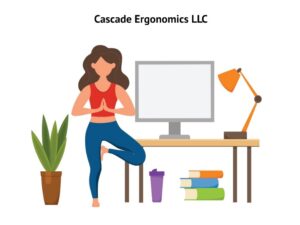 The longer you sit (or stand in one place), the longer the movement break should be.
- The key to comfort is changing posture frequently.
- The key to health is stimulating circulation and breathing by activating larger muscles.
- Even when using a sit-stand desk, you still need movement and stretching breaks.
- Set a timer on your phone or smart watch, try an activity APP or a break reminder device that vibrates or lights up.
Examples of break and postural reminder devices:
Time Cube Plus Preset Timer with 4 LED Light Alarm for
Time Mangement: https://www.amazon.com/TimeCube-Management-Available-Countdown-Settings/dp/B07KGH6B81
Upright Go postural correction device: https://www.uprightpose.com/?gclid=CjwKCAjwz5iMBhAEEiwAMEAwGA3v7JVi9sZ2q_xeIXJL09Pve-Q2KZkO7HS60Ja2I4x9L9wyIWvl4xoCayAQAvD_BwE
Have fun getting creative!
- Take a walking break during the day
- Make some phone calls while walking
- Stretch two muscle groups every time you stand or adjust your sit-stand desk
- Climb stairs during each break
- Add resistance band and body weight strengthening moves every hour
- Add Yoga poses hourly
- Schedule a midday exercise class
- Do some fun dance moves
- Perform 4 cycles of deep breathing exercises
It has been found that many workers enjoy and benefit from active movement breaks as simple as “walking meetings or phone calls”. No expensive ergonomic equipment is required for these solutions.
Be sure to read the blog article: “Sitting Disease – Can Workouts Save You?” https://cascadeergonomics.com/sitting-disease-can-workouts-save-you/
Special Bonus:
Click the following link to download your free PDF that includes both active and static office stretching. For those of you unfamiliar with active stretching, you won’t want to miss out on the benefits. CLICK HERE FOR A FREE PDF OF OFFICE STRETCHES.