

Module 9: Sit-Stand Protocol For Adjustable Height Desk Users
There’s no doubt adjustable height sit-stand desks can be helpful for improving comfort. Yet they are only helpful when used correctly. It is surprising how many workers with adjustable height desks actually miss out on the benefits in three ways:
1: Standing too long
Ask warehouse and assembly line workers what it feels like to stand all day at work. Many will report that by the end of the day their feet, legs, and low back HURT. For office workers, static sitting for long periods of time can also be quite uncomfortable.
What is the right sit/stand balance?
Thankfully, this question has been investigated. As you might have guessed, the key to comfort and health is changing postures often. For a long time, research has recommended standing no longer than 30% of the workday or 15-30 minutes at a time to protect discs in the low back. However, more employees in a recent study actually preferred and tolerated standing between 30-50% of the workday (https://www.tandfonline.com/doi/abs/10.1080/00140139.2017.1353139?journalCode=terg20).
- The study found that the ideal sit/stand ratio for many office workers seemed to fall between a 1:1 ratio (60 minutes sitting/60 minutes standing) and a 3:1 ratio (sitting three times longer than standing).
- The study found an increased ergonomic risk when standing for longer than 1 hour at a time or when standing over 4 total hours during one work shift.
- The study concluded that more active break-time activities may be better at reducing muscle fatigue and foot swelling that just standing in place at your desk.
- The sample size in the study was limited and did not specify if participants typically had back pain, leg swelling or other joint and health issues. Obviously more research is needed in this area. Therefore, we would not expect everyone to able to tolerate standing up to 60 minutes at one time without symptoms or increased ergonomic risk.
Some tips to help guide you:
| You need to find the right balance in your sit-stand schedule that works for you. Just be sure not to stand longer than one hour at a time, 4 hours in one workday or 50% of an 8 hour day. Exception: If a serious back condition limits your ability to sit comfortably, then you may need to stand up to 50% or more of the workday. |
| Aim to stand around 30-50% of the workday based on your own comfort and for the least amount of ergonomic risk. Even though standing 15-30 minutes at one time has been recommended for a long time, you may stand up to 60 minutes at a time safely IF your body tolerates this well. |
| Start with shorter periods of standing and gradually increase time as tolerated. |
| Alternate between sitting and standing approximately 1-2 times per hour. |
| Add a footrest or small step to rest one leg at a time or practice shifting your weight back and forth. |
| Avoid locking knees when standing and keep your low back and pelvis in a neutral posture. |
| Sit down whenever you feel fatigue or discomfort in the feet, legs or low back. |
 Caution
- Forcing yourself to stand longer than one hour at a time may cause discomfort and joint stress.
- Pushing your body to continue standing even if back, leg or foot discomfort develop may also increase joint stress.
- Prolonged standing may increase the tendency for legs and ankles to swell.
- Static standing does not lead to significant calorie burning as some desk companies would like you to believe.
- Static Standing is NOT a substitute for healthy movement breaks.
- Movement breaks are designed to improve comfort, circulation and overall health through larger dynamic movements, walking, stretching or light exercise.
2: Not using your adjustable sit-stand desk for standing
This scenario is more common than you would think. People who have an adjustable sit-stand desk often forget to use it. That’s one of the reasons employers are reluctant to invest in this equipment for employees.
- Before investing in a sit-stand desk, spend several weeks committing to the recommended standing and movement breaks in Module 10.
- This will ensure that longer periods of standing actually do improve comfort and that a sit-stand desk would be beneficial.
- This will help you form healthy habits and confirm your commitment to using an adjustable sit-stand desk properly before you spend money on one.
- Some workers discover that movement breaks provide enough comfort that they do not need to invest in sit-stand equipment.
3. Sit-stand desk is not adjusted properly
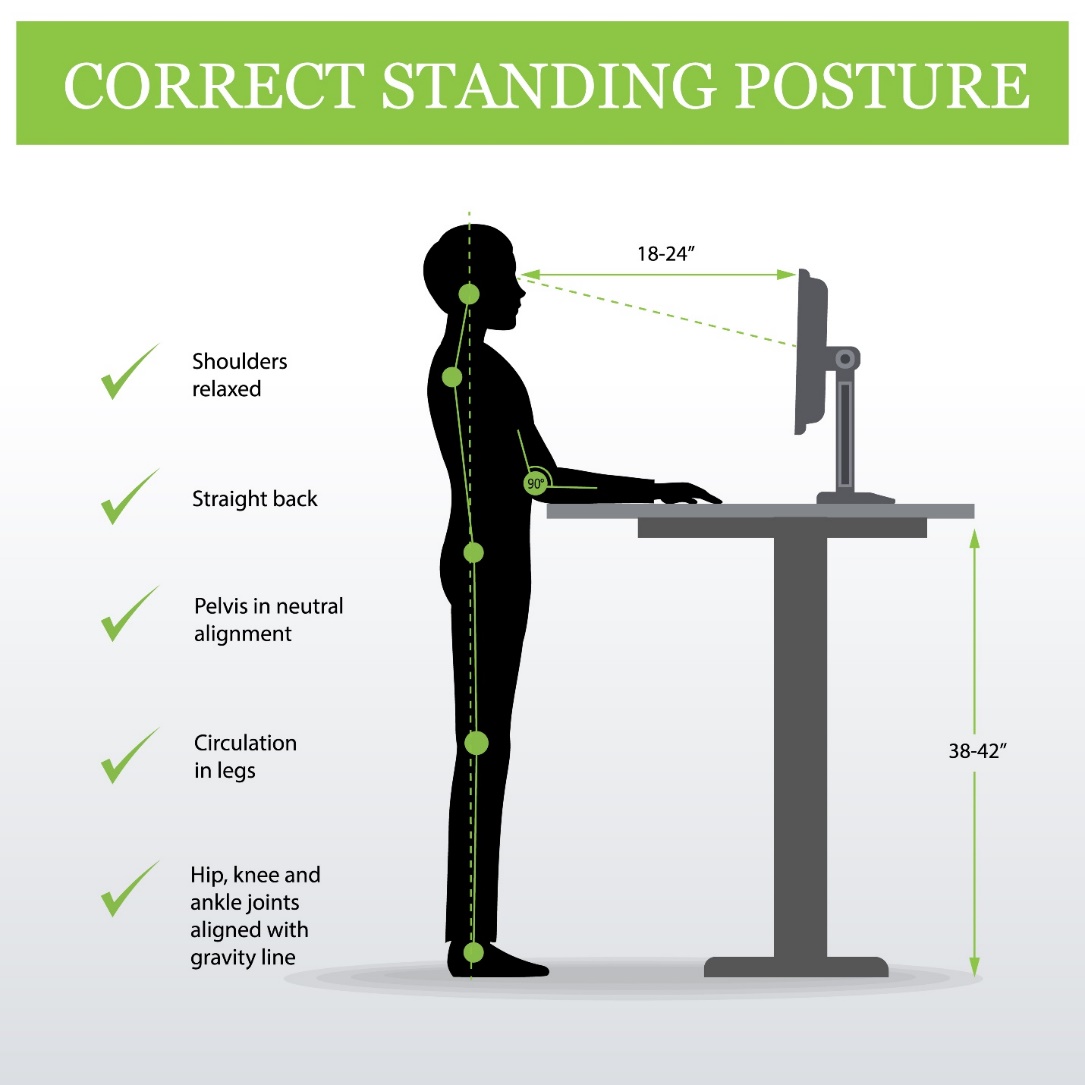
- Use the image below as a guide for setting your desk height (similar to sitting posture).
- Raise the desk until forearms are approximately level when typing.
- Elbows should be bent approximately 90-110 degrees.
- It is OK for monitors to feel slightly low when standing (your waist lengthens in standing).
- If you have an adjustable monitor arm, feel free to raise the screen height so that eyes are level with the top 2-3 inches of the screen.
Caution
Do not begin using an adjustable height sit-stand desk without consulting your physician if you have cardiovascular disease, joint or other health conditions that may be affected by standing intermittently.
Standing mats
Ergonomists tend to argue about whether standing mats are necessary.
Pros:
- Standing mats can greatly improve comfort when working without shoes or in less comfortable dress shoes.
- A few standing mats have contours and protrusions to challenge your balance or promote exercise which some employees enjoy.
Cons:
- Standing mats cannot be used under the wheels of your chair which forces you to bend down to remove or replace the mats each time they are used.
- Some people use mats to try to increase standing time beyond healthy limits. When you feel fatigue or soreness, it is your body’s signal to sit down.
The few seconds it takes to raise and lower the sit-stand desk provides a great opportunity to stretch and take hand and eye breaks. Let’s jump to the next module and dive deeper into movement strategies for comfort and health at work!